
📌 Introduction: Markets Reverse Course in Dramatic Fashion
On January 12, 2026, Indian equity markets surprised investors with a sharp turnaround in a single trading session — a move now widely referred to as the Sensex Nifty Market Recovery 2026. After a volatile morning where both the BSE Sensex and NSE Nifty 50 indices plunged, markets flipped into strong gains before closing significantly higher. This rapid recovery not only erased early losses but also injected renewed optimism into a broader market narrative that had been weak over the first days of the year.
To understand what happened, this article breaks down the market moves, the key triggers behind the rebound, and what it means for investors in the near and medium term. We will explore the macroeconomic backdrop, geopolitical influence, technical support levels, and trader psychology that collectively fueled this rebound.
📉 A Tough Start: Indian Markets Under Pressure
Before the recovery, markets were struggling. In the early session, both the Sensex and Nifty opened lower and extended losses from previous weeks, reflecting deep investor caution. Global headwinds, tariff concerns, and foreign fund outflows had kept sentiment fragile.
Specifically:
- The Nifty dropped below 25,600, breaching a key psychological and technical support level.
- The Sensex slipped over 700 points earlier in the day before reversing course.
Such volatility is often interpreted by traders as a sign of either market exhaustion or approaching trend reversal — and in this case, it became a set-up for a strong rebound later in the session.
🔁 The Sudden Reversal: Market Recovery Explained
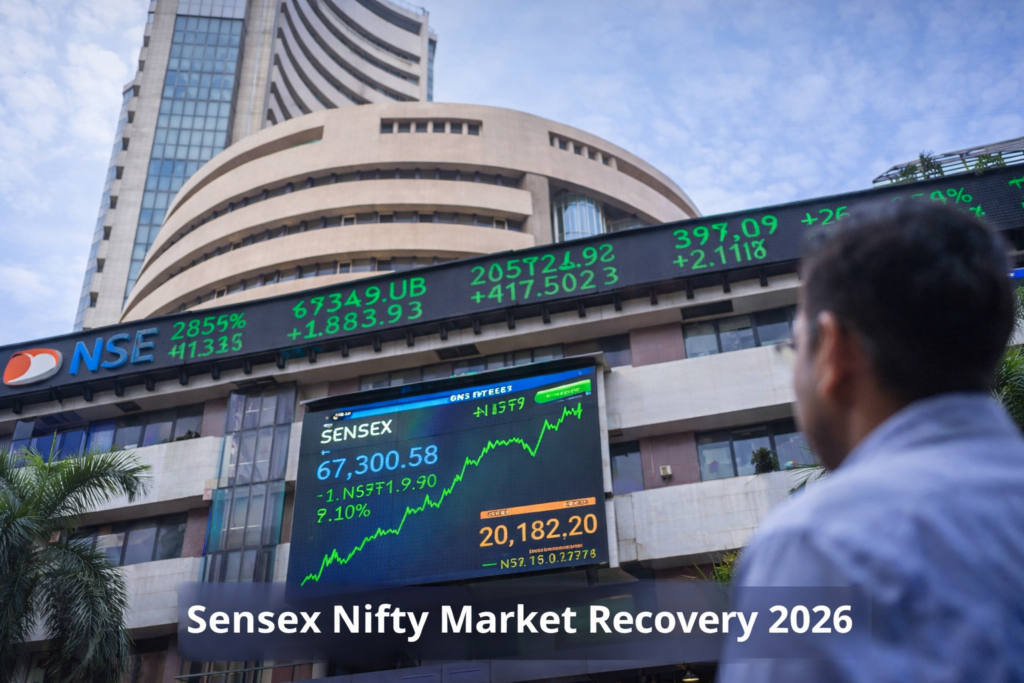
By the afternoon session, both indices had erased much of their early declines and turned positive — a hallmark of the Sensex Nifty Market Recovery 2026.
sador Sergio Gor
The single largest catalyst behind the recovery was a set of comments by U.S. Ambassador to India Sergio Gor suggesting progress in trade discussions between India and the United States. According to markets coverage, his remarks emphasized:
- Strong strategic partnership between the two countries
- Continued active engagement on trade negotiations
- Plans for a future call on the trade deal imminently
This triggered optimism among investors, easing fears around tariff uncertainty and boosting risk appetite.
🧠 Why It Mattered
India is among the world’s fastest-growing major economies, and stronger trade ties with the U.S. are seen as supportive of corporate earnings and foreign investment flows. When diplomatic dialogue shifts from uncertainty to cooperation, equities often reflect that optimism.
This one comment was enough to flip investor mood, turning price action strongly positive after a brutal start.
📊 2. Technical Bargain Buying
When indices drop steeply, many traders watch for key technical support levels — price points where historically buying interest appears. On January 12, major technical analysts pointed to:
- Nifty recovering above the 25,700 zone
- Intermediate support at 25,600 and 25,500
- Short-term oversold conditions prompting short covering
Once the indices stabilized and these technical levels were reclaimed, short sellers — anticipating further decline — were forced to buy back positions to lock profits, adding fuel to the recovery rally.
📌 3. Sector Rotation and Broader Market Dynamics
Market recovery was not limited to headline indices (Sensex & Nifty). Small and midcap segments also showed signs of a rebound, though in a more uneven fashion:
- Banking and blue-chip stocks saw improved buying interest
- Some smallcap names continued to lag due to weak earnings
- Defensive sectors attracted flows amid global uncertainty
This pattern suggests that investors were selectively rotating into segments perceived as more resilient or fundamentally stable.
🌍 4. Global Context: Volatility and Uncertainty
External cues also contributed to market psychology. Rising geopolitical tensions — especially in regions like the Middle East — supported commodities like gold and increased overall risk aversion. At the same time, volatility indicators such as the India VIX spiked, signaling heightened fear and uncertainty.
Often, when volatility spikes and then cools rapidly, markets see a rebound as risk-averse traders re-enter positions at lower levels.
🔍 A Closer Look at Index Performance
Here’s a quick snapshot of market behavior during the session:
📈 Sensex
- Early drop of over 700 points
- Recovered later to show significant gains
- Turned positive before close
📊 Nifty
- Fell below key intra-day support levels
- Rebounded above 25,700 after mid-session recovery
- Closed with solid gains across major sectors
Additionally, the Bank Nifty — representing the banking sector — also exhibited a strong turnaround, recovering around 650 points from its intraday low and moving back above key resistance levels.
💹 Foreign Investors and Market Flows
One persistent theme in recent months has been foreign institutional investor (FII) outflows, which put pressure on Indian equities. Concern over U.S. tariffs and global risk assets led to consistent selling pressure.
However, during the recovery session:
- Some of this selling momentum slowed down
- Foreign buyers paused to assess the situation
- Domestic investors stepped in to provide liquidity
While this doesn’t necessarily mark a long-term reversal in flows, it did provide short-term support during the rebound.
🏦 Broader Investor Sentiment
Markets are as much psychological as they are economic. Sudden sell-offs driven by fear often lead to emotional reactions — and equally strong recoveries can be triggered by regained confidence.
On January 12, the sense that worst-case scenarios around tariffs and trade tensions might be avoided was enough to flip sentiment from bearish to cautiously bullish.
📉 Risks and Caution Ahead
It’s important to note that while the Sensex Nifty Market Recovery 2026 was remarkable, some underlying concerns remain:
⚠️ Geopolitical Tensions
Conflict or supply risk in regions like the Middle East could impact commodity prices and inflation dynamics.
⚠️ Foreign Fund Flows
Continued selling by foreign investors can pressure markets even when technical support is found.
⚠️ Volatility Indicators
A rising VIX means markets expect continued fluctuations — traders should watch this closely.
These ongoing risks mean that while markets rebounded sharply on January 12, investors should be prepared for continued volatility.
📍 Key Takeaways: What Investors Should Know
Here’s what the Sensex Nifty Market Recovery 2026 tells us:
✔ Markets can rebound sharply when sentiment shifts
✔ Diplomatic cues can significantly influence financial markets
✔ Technical levels and bargain buying play a critical role in reversals
✔ Foreign investor flows and geopolitical risks remain key variables
For long-term investors, this day highlights how sentiment, macro indicators, and technical levels can interact powerfully in modern markets.
🧭 Conclusion: A Market With Memory and Momentum
The Indian equity market’s sharp turnaround on January 12 reflects a complex interplay of psychology, technical conditions, geopolitics, and news flow. The Sensex Nifty Market Recovery 2026 will be remembered as a session where fear gave way to cautious optimism, and traders once again found confidence in rebounding levels after a period of weakness.
While the broader market environment remains vulnerable to external risks and global uncertainties, this episode shows that even volatile markets can find footing quickly when the narrative shifts just slightly — in this case, on the back of diplomatic reassurance and renewed investor belief.
For traders and long-term participants alike, understanding the why behind market moves — rather than just the what — is often the difference between reacting wisely and being caught off guard.